
Giants Fan Celebrates Clear Vision After Cataract Surgery
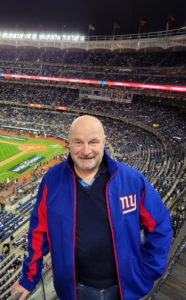
A devoted New York Giants fan, Bruce Barkhorn frequently watches home games at MetLife Stadium in East Rutherford, New Jersey.
When cataracts started affecting his vision, the 75-year-old season ticket holder struggled to see the players’ jersey numbers on the field.
“[My vision] was out of focus a lot, and it got pretty bad the last year and a half,” he said.
When driving at night became difficult, Barkhorn scheduled an appointment with ophthalmologist Shawn Klein, MD, to discuss his eye health and cataract surgery.
What Are Cataracts?
Cataracts form when protein builds up in the lens of your eye. They often lead to vision changes including the following:
- Blurry vision or difficulty seeing clearly or sharply
- Seeing two images of a single object, which often overlap
- Sensitivity to light (notably with oncoming headlights at night)
- Difficulty seeing clearly at night or reading in dark conditions
- Seeing bright colors as faded or yellow
Surgery is the only treatment option to medically remove a cataract. Untreated cataracts may lead to vision impairment or blindness, so it is important not to delay surgery.
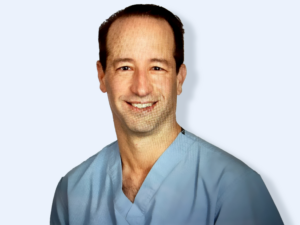 “There are people coming with cataracts that are bothersome for them and affecting the vision to some extent,” Dr. Klein said. “If you wait too long … at some point the surgery actually becomes more difficult, and the risk of complications becomes higher.”
Select an IOL to Meet Your Visual Needs
Cataract surgery remains a safe and common procedure, with around four million procedures performed annually in the U.S.
During cataract surgery, an eye surgeon replaces your cloudy lens with an artificial lens called an IOL, or intraocular lens. An IOL is constructed from silicone, acrylic or another plastic material.
For his visual needs and lifestyle, Barkhorn selected a multifocal lens designed to correct his astigmatism and give him distance and near vision without glasses.
It is important to consult your eye doctor to determine the best IOL for you. There are three major categories of IOLs:
Monofocal Lens: Designed to provide sharp distance vision. Medicare and other insurance plans usually cover it. Glasses may still be necessary for reading and possibly distance vision, especially if you have astigmatism.
Astigmatism-correcting Monofocal Lens: Potentially corrects your astigmatism. Most people only need glasses for reading after surgery.
Multifocal Lens: Can help you see both near and far, so you may be glasses-free after cataract surgery. Health insurance plans do not cover the additional expense of these lenses. To determine affordability, compare the one-time cost of purchasing the premium lenses with the cumulative lifetime cost of buying eyeglasses.
Choose an ASC for Cataract Surgery
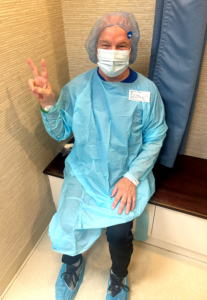 Barkhorn scheduled his cataract surgery at an AMSURG-affiliated ambulatory surgery center (ASC). The first procedure on his left eye was completed in less than 20 minutes. He was at the center for about two hours.
“It was unbelievable how fast, efficient and professional it was,” Barkhorn said. “I was really pleasantly surprised.”
A day after surgery, Barkhorn returned for a follow-up exam. He wore a patch over his eye the first night. The first week after surgery, he applied eye drops four times a day to prevent inflammation. He said his full vision returned within a few days.
Two weeks later, Barkhorn returned to the center for cataract removal from his right eye and achieved the same positive results.
“Anytime you have an operation [on] your eyes, you’re a little hesitant to do it,” he said. “I’m glad I did.”
Dr. Klein said patients benefit from having cataract surgery in an ASC setting. These outpatient centers can perform your cataract procedure at the same high level and quality of care at a lower cost than other medical facilities.
“Even though the surgery is delicate and can be complicated, our surgical teams are proficient with excellent results,” Dr. Klein said. “There’s a very high volume of surgeries to be done, and we can take care of them efficiently and in a comfortable manner for the patients.”
Clear Vision Improves Gridiron Games Experience
Life after cataracts has improved Barkhorn’s NFL game-day experience. He now watches the New York Giants with clear vision — no prescription glasses needed.
“When I go to the football games eight times a year, I can see the numbers on the back of the players where I couldn’t before. So, it’s a good thing,” he said.
Although he no longer needs glasses, Barkhorn still instinctively reaches for them.
“The funniest thing is your brain is conditioned to reach for your glasses all the time,” he said. “And I said [to myself], ‘Wait a minute. I don’t need them anymore’.”
Helping patients like Barkhorn gives Dr. Klein satisfaction in his work as an ophthalmologist.
“You’re restoring vision to people,” he said. “That’s the reason you’re doing cataract surgery, but the idea that you can help make people see again […] really makes it a lot of fun.”
Find an Ophthalmologist Near You
Is your vision blurry or out of focus? Do bright headlights distract you while driving at night? Schedule a visit with your ophthalmologist for a comprehensive eye exam.
“Vision is very subjective. It can be very hard to explain how you feel, what you’re seeing,” Dr. Klein said. “You’ve got to get checked. That’s the answer.”
During your exam, your eye doctor will evaluate your current eye prescription, check your visual acuity and screen you for eye conditions like cataracts, glaucoma and macular degeneration. Prioritize your vision health and call today for an appointment.
This article is designed for educational purposes only. The information provided should not be used for diagnosing or treating a health concern or disease. It is not a substitute for professional care. If you have or suspect you may have a health concern, you should consult your healthcare provider.